
Golfective /Metrics /Head
Head stability in the golf swing: sway, lift and reverse pivot
"Keep your head down" is the worst advice in golf, and also the most given. Your head is not meant to be frozen: it is meant to stay quiet, centred where it started. That is a completely different thing, and it is the one that gets measured.
Your head sits over the centre of the swing, and the low point of the arc follows it. Move it and the club starts meeting the ground somewhere else: let it drift back, away from the target, and the club reaches the turf before the ball — fat. Let it drift forward and the low point moves past the ball; let it rise and the whole arc comes up with it — thins and tops. What matters is not freezing your head, but keeping it within a few centimetres of its address position while your body turns underneath it.
Why head stability matters
It does not take much for the damage to show: two or three centimetres in the wrong direction is enough for the club to catch the ball before or after the low point of the arc. And you rarely notice the movement — it usually comes from trying to help the ball up, or from turning around your shoulders instead of your centre. What the app is looking for is not stillness: it is the body turning underneath a head that stays where it was.
That is why the metric is reported in centimetres rather than as a simple pass or fail. A head that moves two centimetres is a swing that turns; one that moves nine is a swing that slides. The distinction is measurable, and it is the one that shows up in your contact — alongside shaft lean, which decides the loft you arrive with.
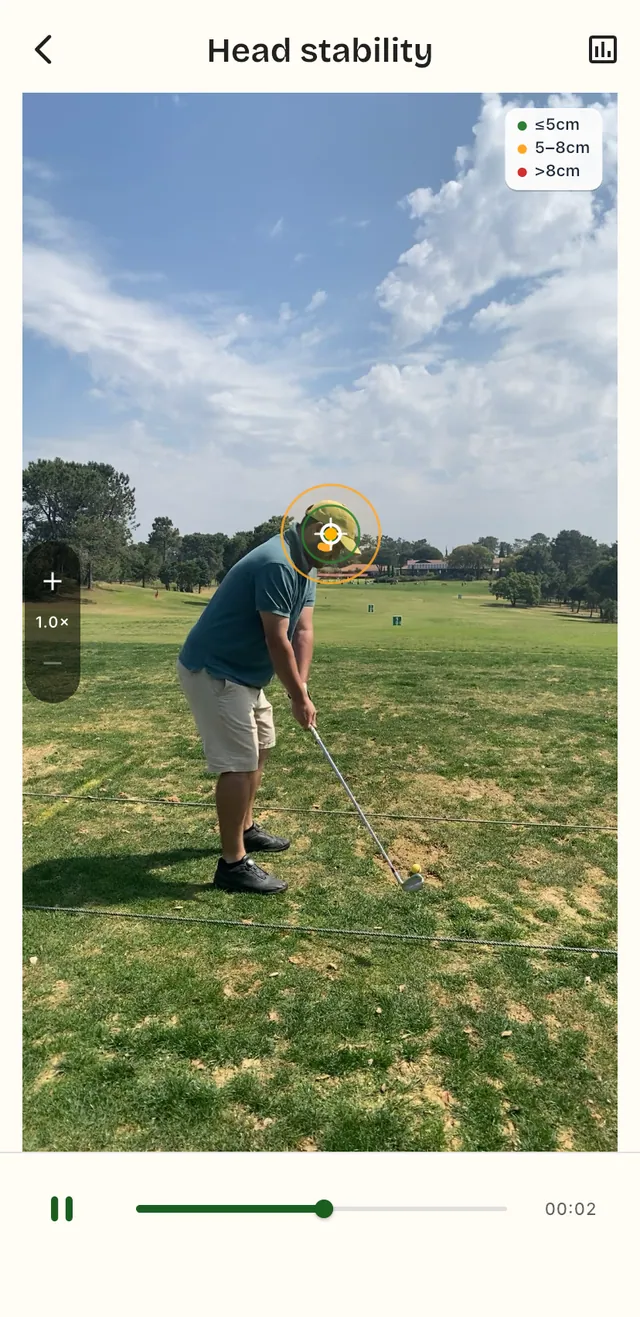
- The anchor — where your head was at address. Everything is measured from here.
- The trace — where it actually went, across the whole swing.
- The peaks — how far it got, in each direction, in centimetres.
The head stability numbers
Head stability is not one number. It is five: the four directions it can move in — back, forward, up and down — plus the deviation at the moment of impact.
One centimetre is a small tolerance compared with the five for sway, and that is no accident. Moving away from the target at least loads weight into the trail foot. Moving towards it during the backswing loads nothing and leaves you falling backwards at impact — it compromises the plane and the contact at the same time, which is why it turns up so often at the top of the priority list.
How to measure your head stability with a phone
Head stability is measured from both angles, and each one sees different things: down-the-line shows lift and drop, face-on shows sway and reverse pivot. Your height, entered once in the app, is what turns pixels into real centimetres.
You put the phone down, step up to the ball and set the club behind it. Club detection recognises the clubhead at address and starts recording on its own; when the swing is over, it stops and analyses. Nobody has to stand behind the camera.
The drill
A drifting head cannot be felt without an external reference. This drill gives you one, and it fits in your pocket.
Tee in the lips
10 half swings, then 5 full ones.
The tee keeps pointing at the ball, all the way to impact.
Do not hold your head rigid. It turns with your chest — it just does not rise, drop or slide.
Frequently asked questions about head stability
Should you keep your head still in the golf swing?
No — a completely motionless head stops your chest turning, costs you power and ruins your plane. Your head should stay within a few centimetres of its address position while the body turns underneath it. Quiet, not frozen.
What is a reverse pivot in golf?
It is the head and torso moving towards the target during the backswing, with the weight going into the lead foot instead of the trail foot. It leaves you falling backwards at impact, and it is the tightest tolerance of the head metrics — under one centimetre.
Why do I hit fat shots and thins?
Usually because the low point of your swing is moving. The low point follows the head, so a head that drops, or hangs back behind where it started, meets the ground early and hits it fat, and a head that rises lifts the whole arc with it and thins it.
How much head movement is acceptable?
Under 5 cm of sway, under 2 cm of lift, under 4 cm of drop and under 1 cm of reverse pivot. At impact, being within 5 cm of your address position is the benchmark.
How do you measure head movement in a golf swing?
Golfective tracks your head through the swing from a phone video and reports the peaks in centimetres, using your height as the scale. No markers and no sensors are involved.
See how far your head travels
Golfective measures sway, lift, drop and reverse pivot in centimetres from an ordinary phone video, and tells you which of them is costing you contact. Free on the App Store.
Download on theApp Store