
Golfective /Metrics /Impact
Shaft lean at impact: why the hands go first
Fat, thin, weak and high. Four misses with one thing in common — the clubhead arriving at the ball before the hands do. Shaft lean is the number that describes it.
Shaft lean is how far the shaft leans towards the target at the moment of impact, in degrees. Good iron players arrive with their hands ahead of the clubhead, roughly +4° to +10°. That lean is what compresses the ball and delivers the loft the club was designed to deliver.
Why shaft lean matters
At impact, good ball strikers have their hands slightly ahead of the club — that is what compresses the ball into solid, ball-first contact, and turns clubhead speed into distance. When you scoop (hands behind, trying to lift it), the club decelerates: fat shots, thins, and high weak ones. That lean comes from the sequence of the body, not from forcing the hands.
The instinct to help the ball up is what produces exactly the opposite. A sand wedge already comes with 56 degrees of loft from the factory — it needs no help at all getting the ball airborne. Lifting it with your wrists only adds loft to what is already there, and the ball goes higher and shorter. Lean decides the loft you arrive with; where the club meets the ground is the low point, and that one follows your head.
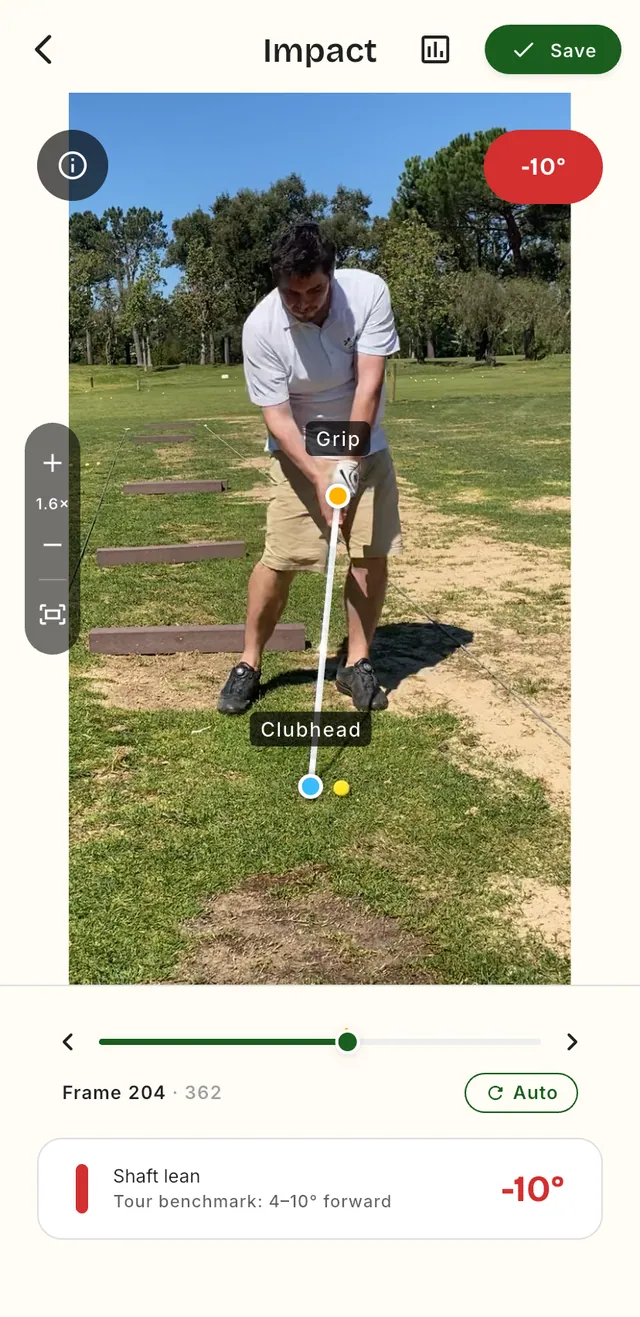
- The shaft line — drawn from the clubhead to the hands, on the impact frame.
- The vertical — the reference. The angle between the two is your lean.
- The sign — positive is leaning towards the target, negative is leaning back.
The shaft lean numbers
The right lean depends entirely on the club in your hands, so the benchmark moves with it. Positive means hands ahead of the clubhead; negative means hands behind it.
Lean is one of the few metrics with a real ceiling. Above about 14° on an iron you are taking so much loft off the club that the ball comes out low and running, with no stopping power, and the low point of the arc moves too far ahead of the ball — deep divots and low contact on the face. The app puts limits on both sides for exactly that reason: too much lean is flagged as readily as too little.
How to measure your shaft lean with a phone
Shaft lean needs a face-on view — camera in front of you, square to the target line. From down the line, forward lean is hidden, because it happens straight towards the camera. It is the same view that gives you your setup numbers.
You put the phone down, step up to the ball and set the club behind it. Club detection recognises the clubhead at address and starts recording on its own; when the swing is over, it stops and analyses. Nobody has to stand behind the camera.
The drill
Scooping is not fixed by thinking about your wrists. It is fixed by hitting shots it cannot fit into — which is what this drill does.
Stop after the ball
15 punch shots — low, with the finish cut short — then 5 normal ones.
Hands go first. The clubhead follows.
Confusing leaning the shaft with holding the face open. The shaft goes ahead, but the face still has to rotate.
Frequently asked questions about shaft lean
What is good shaft lean at impact?
For a mid-iron, +4° to +10° of forward lean. Wedges ask for a little more, +6° to +12°. A driver is different — it is struck on the way up, so anything between 3 degrees back and 3 degrees forward is correct.
Does shaft lean add distance?
Indirectly, yes. Forward lean compresses the ball and produces ball-first contact, which is what turns clubhead speed into ball speed. Scooping decelerates the club through impact, so you lose speed exactly where it counts.
Can you have too much shaft lean?
You can. Above about 14 degrees on an iron the club is so de-lofted that the ball flies low with little spin and no stopping power, and the low point of the arc ends up too far ahead of the ball: deep divots and low contact on the face. It is flagged as a fault in both directions.
How do I stop scooping the ball?
Scooping is usually a sequencing problem rather than a hands problem — the body stalls and the hands take over. Punch shots that finish low, with the feeling of the hands leading through the ball, retrain the order without you having to think about your wrists.
How do I measure shaft lean at home?
From a face-on phone video. Golfective finds the impact frame, draws the shaft from the clubhead to the hands and reports the angle against vertical, so no launch monitor and no sensors are needed.
See your lean at impact
Golfective finds your impact frame and measures shaft lean from a face-on video, against the benchmark range for the club you hit. Free on the App Store.
Download on theApp Store