
Golfective /Metrics /Setup
Golf setup: ball position, stance width and spine tilt
It is the only part of the swing you build with no time pressure, and the only one you can measure standing still. It is also where a surprising number of "swing faults" are born.
Your setup preloads everything that follows. Ball position, stance width, spine tilt, knee flex and how far you bend from the hips all have a measurable range — and each one changes with the club in your hands. A driver setup and a wedge setup are supposed to be different.
Why setup matters
A wrong ball position, a bad alignment or a slumped posture all force a compensation somewhere later in the swing to make up for them — and those compensations turn up as fat shots, thins, and balls pushed right or pulled left. Plenty of "swing faults" are really setup faults in disguise. (Directions are for a right-handed player.)
That last point is worth stopping on. If the ball is five centimetres too far back, you will instinctively invent a move to reach it, and it is that invented move a coach later sees as your swing fault. Fixing the position removes the need for the compensation, and the fault disappears without ever being worked on. It is the same mechanism behind a good share of plane and shaft lean problems.
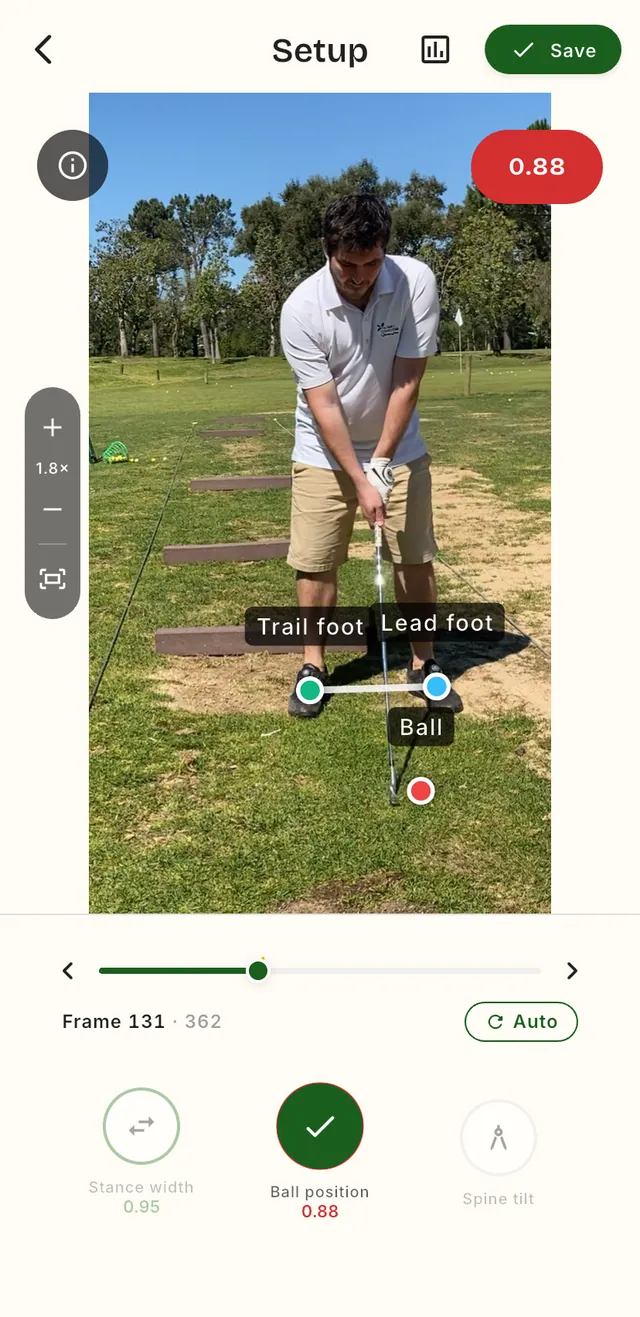
- Your stance — measured foot to foot, and then used as a ruler.
- The ball — reported as a fraction of that stance, counting from the trail foot.
- The range — the target values for the club in your hands.
The setup numbers
All of these ranges move with the club. These are the iron values, with the driver shown where the difference is largest.
Driver 0.80–0.95
Driver 1.05–1.25×
Driver 7–12°
Ball position given in centimetres is useless, because it depends on how wide your stance is. Reporting it as a fraction of your own stance makes the number comparable between players of any height and build — and it lets the app tell you the ball is too far back even when your stance is unusually wide.
How to measure your setup with a phone
Setup is measured face-on for ball position, stance width and spine tilt, and down-the-line for the bend from the hips and for how the hands hang under the shoulders.
You put the phone down, step up to the ball and set the club behind it. Club detection recognises the clubhead at address and starts recording on its own; when the swing is over, it stops and analyses. Nobody has to stand behind the camera.
The drill
Ball position is not trained by hitting balls. It is trained by building it, club by club, until it stops being a decision.
Two clubs
3 balls with each of the five clubs, from wedge to driver. Reset the two clubs on the ground every time you change club.
Wedge back of centre. Driver off the lead heel.
Fixing the whole ball position in one go. Move it one ball-width at a time — too far back comes out thin and right.
Frequently asked questions about setup
Where should the ball be in my stance?
It changes with the club. For a mid-iron, centre to just forward of it — about 0.50 to 0.58 of your stance measured from the trail foot. A driver sits well forward, 0.80 to 0.95, roughly off the lead heel. A wedge sits back of centre.
How wide should my stance be?
Relative to your shoulders, not in centimetres. An iron asks for roughly shoulder width, 0.90 to 1.05 times. A driver asks for wider, 1.05 to 1.25 times. A wedge is narrower, 0.70 to 0.85 times.
What is spine tilt at address?
It is how far your torso leans back, away from the target, as you set up. An iron asks for 3 to 7 degrees; a driver asks for 7 to 12, because you are trying to strike the ball on the way up rather than down on it.
Can setup really cause fat shots and thins?
Often, yes. A ball too far back or a slumped posture force a mid-swing compensation to reach it, and it is that compensation that produces the fat shot, the thin, the push or the pull. The fault shows up in the swing but is born before it starts.
How do I check my setup at home?
From a face-on video, without even hitting a ball. Golfective measures ball position, stance width and spine tilt against the range for the club in your hands, using your height as the scale.
Check your setup in 30 seconds
Golfective measures ball position, stance width, spine tilt, knee and torso against the range for the club in your hands. Free on the App Store.
Download on theApp Store